
If you are building, buying or renovating your dream home, read this. The full story of how we design smart homes, why we do it this way and what you get.
This is the full version. The short summary is on the smart home design page.
Hello! If you're reading this, you are most likely designing or building your dream home. Congratulations — it's always an exciting time.
You're probably looking for advice on your smart home and the rest of your home technology. Good news: you're in the right place. My team and I can help. Let me share everything right now, with no fluff.
How do you know which technology suits your home best?
There is a huge number of smart home solutions on the market. And you'll certainly find a lone guru, a dealer or a very experienced company telling you that their solution is the one for you.
So how do you decide? The truth is that almost everything on the professional smart home market is an excellent system.
Here is the key advice
First understand how you want to use technology at home. For example, what do you want to be able to do in the kitchen?
- Listen to music, podcasts, audiobooks?
- Watch YouTube videos while you cook?
- Shade the sun that shines straight into the window while you eat?
- Create atmosphere with layered light: pendants, in-cabinet and under-cabinet lighting?
- Keep a "piano" of switches pointing in all directions on the wall — or have one very functional keypad?
- Easily see what's happening in the rooms or at the pool where the children play, and open the door without leaving the kitchen?
Notice: I'm not asking whether you want "speakers", "shades" or "cameras". I'm asking how you'll use your system. Your answers set the direction and the technology of your smart home.
"If you were building your own house today, which smart home would you choose?"
Clients ask me this all the time. My favourite platform is Control4 — simply a personal preference. As for interfaces, I really like Savant's graphical interface.
But if I were building my house right now, I wouldn't choose Savant, and here's why. When I look at my wish list and how I want to enjoy my home, I want biodynamic lighting, serious security — intrusion and fire alarm — and high-quality music. In my experience Control4 works more reliably with security systems and camera feeds, so to integrate everything I love, I'd choose Control4.
It may not be obvious to you, but in the automation market this is a real problem.
That's why the design approach is decisive
Most systems are designed system-first rather than user-first. KNX, HomeKit, Alexa — you've surely heard these words.
Back to the kitchen. Say you tell me you want an audio system there. With a system-centred approach we'd say: "Great, let's put in Control4 multi-room audio." With a user-centred approach we ask: what exactly do you want to listen to? And the list becomes:
- Apple Music;
- audiobooks;
- podcasts from your phone;
- a YouTube video — from another room, too.
Say you want Apple Music. For a long time Control4 didn't support it natively. You can stream via AirPlay now, and it works, but if you need more flexibility we'd probably consider a different audio streamer for that zone. I call this "user-centred design".
Why should it matter to you?
Three reasons owners are disappointed with their smart home — and how to avoid them
If you don't like your system, it's for one of three reasons.
- You don't use it. Either it's complicated, or it isn't what you wanted — you can't play your Apple Music playlist or listen to audiobooks straight from your phone.
- You spent money on something you didn't need. After installation you realise you don't use a feature and never needed it. Now it's in your home, reminding you every day of wasted money.
- You feel it was a bad investment. A smart home of any size is an investment. In our experience an owner typically spends 5–10% of the total build budget on smart technology — and clients who believe the fairy tale "they'll do it better and cheaper just for me" regularly spend twice as much. If you're unhappy with the system, you'll hate the investment.
Only by reducing the system to user-centred solutions can you avoid this. If you know how you'll use technology at home, you can design a system you'll enjoy for many years.
And that is the challenge for us
Every manufacturer wants you to buy only its products. Distributors put strong financial pressure on installers to sell the "right" product. Systems like Control4, Savant or KNX are usually an installation company's main source of revenue, and if it misses its sales targets, it loses its dealer discount or even the right to sell the brand.
I want to be clear: I'm not saying installers have bad intentions. The ones I know want you to have a great system and work hard for the best result. But the reality is that if you tell an installer "I want to listen to music", they'll sell you the brand they carry.
Will those solutions be bad? No. Can it all turn out well? Of course. But too often the result is the same three disappointments. Nobody falls for it twice, and instead of comfortable, technology-rich homes we see buildings that look beautiful but are inconvenient to live in.
How our design differs from an installer's proposal
For more than ten years we've sold and installed smart home systems and home cinemas. We were doing it back in 2011, when only very wealthy clients could afford to make a home "smart". Long before mass-market DIY solutions, our clients' homes cut heating costs in empty rooms and switched off façade lighting at 4 am.
Today our main focus is design and consulting: smart homes, cinemas and budget optimisation for owners and developers of premium homes. The buyer should get a superb, technology-rich home at a sensible cost, so automation doesn't eat the whole margin of the project.
So there is no financial pressure on us from distributors to sell you a particular brand, technology or "turnkey" system. That gives us the freedom to design your system user-first — personally for you. If you tell us you want Control4 and halfway through it turns out Loxone fits better, we'll help you go that way.
It's your home and your system. We win when you love the design, not when you buy a particular brand. Because you'll tell your friends and neighbours about your success — and there will be more truly smart homes.
How our design service works
After you order the service, you send us your floor plans and our engineering team starts designing a custom system. The work has two stages.
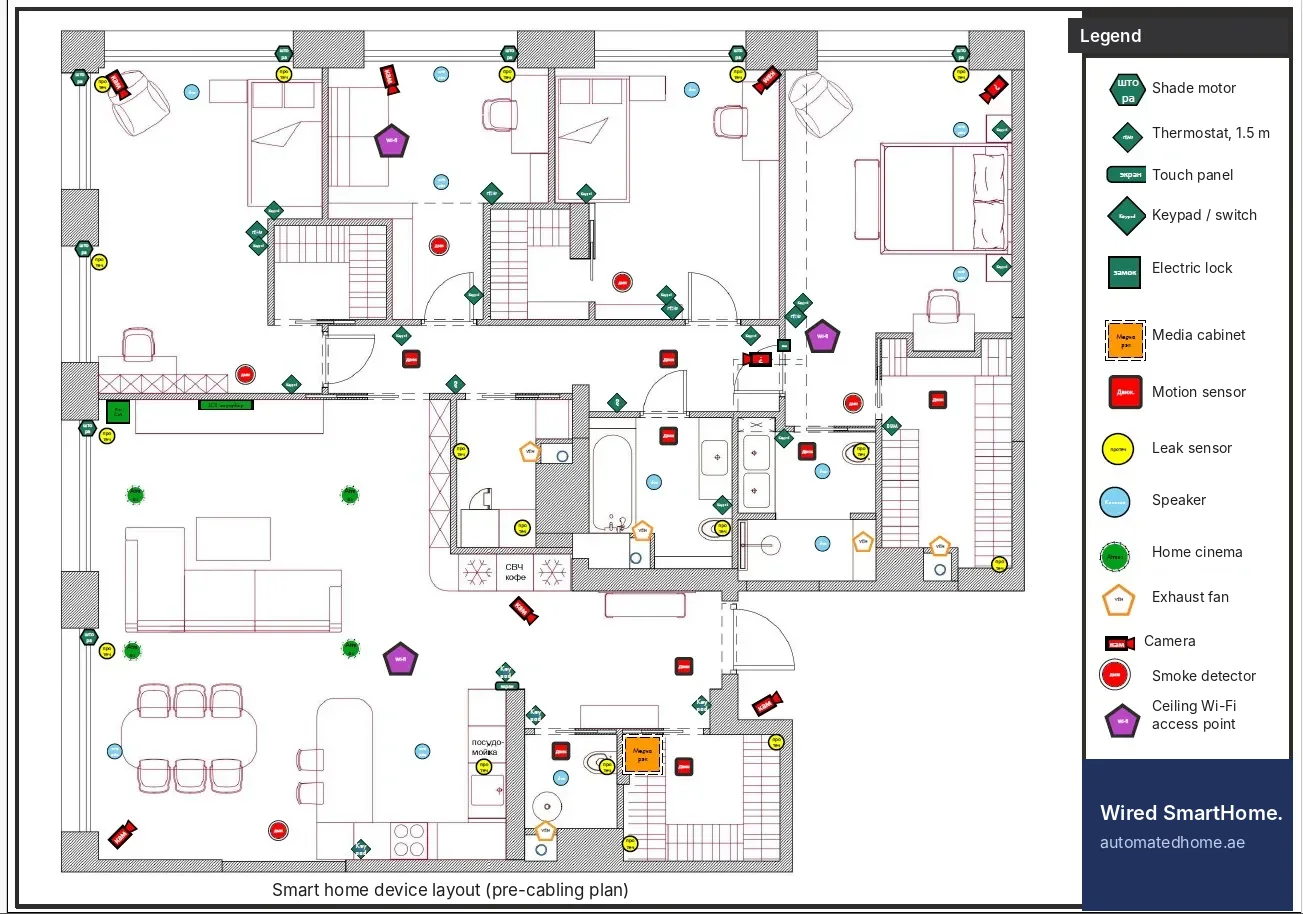
Stage one: "the perfect layout"
We design an absolutely complete smart home system based on our experience. The result includes:
- A prewire plan you can hand to any installation company for detailed design and pricing.
- A budget estimate for Control4 and premium KNX components. We don't use plain KNX as the only system: it is poorly suited to controlling audio, security and complex logic.
- A proposal for the detailed engineering of your automation system based on the agreed tasks and components.
Note: the usual 300-line quote with a part number on every line and a total at the bottom is not what we deliver — for one simple reason: a list of devices with part numbers means nothing without the installer's work. Our budget includes the equipment needed for your tasks, but it's a "complete dish", priced differently from "parts + installation".
What you definitely don't want is to move in, learn about some technology and think: "Why didn't anyone tell me this was possible!" That is the goal of stage one: we send a full set of plans so you can see the final result.
We don't use DIY solutions, random Zigbee relays from marketplaces or hobby controllers — anything with the slightest hint of sudden failure. Your system will always control all engineering systems and devices centrally: lighting, shades, security, gates, cameras, music, TVs, humidification, ventilation with AC and underfloor heating.
Stage two: "cut everything unnecessary"
We answer your questions on the first version and adjust it to how you think you'll actually use the system.
For example, for a homeowner we put speakers in every bathroom, so you can shower to your favourite music or the news in the morning. In a developer's version, only the master bathroom and the guest bathroom get sound.
The plan helps you see where to place speakers, smoke detectors and Wi-Fi access points. With this document your interior designer can make changes far more easily than guessing "where will the Wi-Fi go?" — and why everyone complains about the access point in the wardrobe. You'll see which devices and modes you want in each room.
Based on your feedback we update the plan. The calculations that come with it help you set a realistic budget, adjust the plans tied to the overall build budget and see how to scale the system in phases over time.
The cable schedule helps if you plan to do the wiring yourself — or lets you check that whoever wires your home runs the right cables to the right places, so the system can be expanded easily.
In stage two we reduce or extend the functionality specifically for you and send the final set of plans.
Support afterwards
Once you receive the second and final set of plans, the design service is complete. But we know you'll have questions about the technology throughout the build. You can hire us to supervise your contractors under a separate agreement, and you can always book a video call to discuss whatever matters to you at the moment.
How to start
We need a PDF copy of your floor plans. A general layout is enough, but a full interior design project helps us understand the designer's intent. Electrical plans are a plus, but most of all we need a furnished layout.
After you order, you'll receive instructions on where to send the PDF. An engineer will contact you, make sure you can access the questionnaire and confirm we've received your plans. It takes the team 10–14 working days to complete stage one and send you the first set of plans. You will receive:
- The prewire plan — the best places for speakers, cameras, Wi-Fi and more; you'll check how each room will be used.
- A budget estimate for Control4 + KNX or any combination — to set a realistic budget, compare systems and choose yours.
- A proposal for designing your automation system based on the agreed tasks and components.
Price
Apartment
up to 400 m²
AED 2,300
Villa or house
first 990 m²
AED 4,000
Who we are
If you're new here, you probably wonder who we are. We have designed and installed smart homes and home cinemas for more than ten years. A few years after we started, we moved into premium residential projects for very demanding clients. Homes built for sale with our systems regularly sold while still under fit-out — their value compared with similar properties was higher.
People started filming reviews of our projects, and soon owners from other cities and countries called to ask us to advise on their smart homes. We created our design service to help them. Today we work with clients worldwide, and in the UAE we also install systems with our own certified team. More about us.
P.S. If, like me, you scroll long texts to the end — here's the summary
We have designed and installed smart homes for over a decade. Today our main focus is design and consulting for smart homes and home cinemas. You send us PDF floor plans. We send you a complete set of plans, including a budget for Control4, Savant and KNX. It costs AED 2,300 for an apartment or AED 4,000 for a house, and you'll have it soon.
Questions clients ask most
What file type do you need?
PDF.
What if we are renovating but have no plans?
It's not ideal, but we work with hand-drawn plans too.
How long does the design take?
Stage 1 and the first draft take 10–14 working days. Stage 2 depends on the system's complexity and the scope of your questions and changes — usually 48–72 hours, but it can take a few weeks.
Can we pay as a company?
Yes.
Do you do the installation?
We can — in the UAE we have our own certified team. But the design is made so any qualified installer can build it, so you are free to choose someone closer or less expensive.
So after the design I can hire any local installer?
Yes. Think of it like hiring an architect: the architect designs the house, the builder builds it. We help you design the system, an installer helps you install it. It's standard in commercial projects, and residential is moving the same way.
Which systems do you design for?
Control4, Savant and KNX. We don't study every system on the market — hobby controllers, open-source platforms and so on. Our three systems give enough knowledge to understand how to replace parts of almost any system.
Will you review my existing equipment list?
No. Every project is designed as a "new system". If you already own a surround receiver or speakers, great: for design and budget we assume everything new, and you can substitute what you have. We don't check online wish lists for compatibility.
Is centralised lighting design included?
No, it is a separate job and a separate option, as are full electrical and low-voltage engineering drawings with cable routes. Within the design we give approximate estimates for wired and wireless lighting and recommendations.
Is a 3D model included?
No. It is part of our full engineering design service and can be added at any time. For a cinema or media room, the design includes an equipment layout and several equipment combinations to understand the budget, but VR visualisation and room design are a separate service.
Find out what your home needs — and what it will cost
Get a free smart home planFree and with no obligation · No pushy calls — we reply where you prefer
